 Back to General Comments


Most menus are in English, but it doesn't matter much because they are full of the local dishes which won't mean much to foreigners. It takes quite a bit of work to find anything on a menu that resembles traditional American or European foods.
For the most part, all the restaurants work on an ala cart basis. Everything is ordered separately. You would pick a main dish, for example, then select a vegetable, soup and rice to go with it. Each item would have a separate price associated with it. When ordering in the Philippines you might as well forget the phrase, "what comes with that", and just assume nothing. In fact, if you did ask that question you would be in for some strange looks from the waiter.
Most restaurants tack on a 10% service charge (ie. "Tip") automatically. Unfortunately, with the addition of this extra cost goes all the wait staff's incentive to deal with you. Expect service to be lousy or non-existent. Then, if a waiter does happen to come over to your table by accident, you will be pleasantly surprised. The rule of thumb seems to be: once you get your food, you are on your own. You may need to stand up and wave your arms to get a waiter over to your table after you have been served.
Be prepared for everything to arrive at the table whole and on the bone. Fish dishes will most likely arrive on the plate sporting not only all the bones but the head, tail, scales (and possibly a hook and line). Shrimp will also arrive intact with head, tail, and legs still attached. Chicken will be served with bones not only in main courses but even in soup dishes.
Several of the restaurants we ate at offered what they referred to as an "American breakfast". These orders usually consisted of one egg, two or three pieces of toast, some bacon or sausage and a fruit or fruit drink such as orange juice. How they figured that Americans only want one egg on their plate is beyond me.
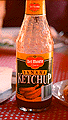 Don't be surprised when you find the Filipinos have messed with
the traditional tomato ketchup we are so addicted to in the United
States. It is not at all uncommon to see banana ketchup used
in it's place. That's right, banana ketchup. At first glance
the appearance is the same. The name brand is even Del Monte.
It had the same type of glass bottle and same red color, but a
close look at the label reveals a picture of a banana instead
of a tomato. The look and consistency of the banana ketchup is
much the same as tomato ketchup. It tasted surprisingly like tomato
ketchup, or should I say surprisingly unlike bananas. I dislike
bananas but had I not noticed the label on the bottle I probably
would not have even noticed the difference. Once I knew what
to look for I was pretty sure I could distinguish the two, but
a blind taste test would have been an interesting challenge. Tomato
ketchup is also available but it must have been more expensive
because we saw it more frequently in the better restaurants.
Don't be surprised when you find the Filipinos have messed with
the traditional tomato ketchup we are so addicted to in the United
States. It is not at all uncommon to see banana ketchup used
in it's place. That's right, banana ketchup. At first glance
the appearance is the same. The name brand is even Del Monte.
It had the same type of glass bottle and same red color, but a
close look at the label reveals a picture of a banana instead
of a tomato. The look and consistency of the banana ketchup is
much the same as tomato ketchup. It tasted surprisingly like tomato
ketchup, or should I say surprisingly unlike bananas. I dislike
bananas but had I not noticed the label on the bottle I probably
would not have even noticed the difference. Once I knew what
to look for I was pretty sure I could distinguish the two, but
a blind taste test would have been an interesting challenge. Tomato
ketchup is also available but it must have been more expensive
because we saw it more frequently in the better restaurants.
Be prepared to eat with animals. Many of the restaurants had some type of animals running around. Dogs and cats are the most prevalent animals roaming around, but chickens, pigs, and other animals will also be found on occasion. The further you get out into the remote provinces the more acceptable these dining standards become. Animals are not allowed in dining establishments in Manila and popular restaurants outside Manila.
Another interesting observation is that all the dogs we saw were young. There were a lot of dogs running around all over the place, but we only saw one or two that had grown past the stage of puppyhood. From these observations I drew the conclusion that many of the animals wound up served with rice!
The health of the animals is generally poor. Many are skin and bones with large sores and patches of missing hair. They often seem oblivious to the presence of humans and some, not surprisingly, are a little wary of them. They all appear to be leading a rather miserable existence.
The local markets are full of bananas, pineapples, papayas, mangos, coconuts and countless other fruits. Only a few of these fruits are available in the United States. The taste and consistency of the of freshly-picked tree-ripened fruits available in the Philippines are almost unparalleled. The bananas were smaller than those that make it to the United States but everything else look about the same. In Manila, there was even a 24 hour fruit market just around the corner from our hotel.
In the open markets you will see vendors selling sliced pineapples, opened coconuts, and other prepared fruits. These items look tempting but it is best to avoid them. Any uncut fruits are fine but anything you buy that is already sliced could be trouble.
 Coke
and other soft drinks are available primarily is bottled form.
The soda fountain mixed drinks are very rare. Canned pop is available
in some locations but it was more expensive. The bottles are
worth as much or more than the fluid was and had to be left at
the store. If you wished to purchase a soft drink to go it will
be poured into a small plastic bag with a straw.
Coke
and other soft drinks are available primarily is bottled form.
The soda fountain mixed drinks are very rare. Canned pop is available
in some locations but it was more expensive. The bottles are
worth as much or more than the fluid was and had to be left at
the store. If you wished to purchase a soft drink to go it will
be poured into a small plastic bag with a straw.
Sometimes you never really know what you like until you are without it for a while. The one dessert item in short supply in the Philippines was chocolate. There wasn't a single restaurant we ate at that offered a chocolate item on the menu. There is a Filipino chocolate bar on the market, but it has a much different taste than American chocolate. We did see a few places that sold Nestles and Hershey chocolate, but they were few and far between. I brought a bag of miniature Halloween Hershey bars with me from the United States and we relished them as the last vestige of the country we temporarily left behind.
One of the more interesting dessert items we saw was gulaman which is basically Jell-O. Uncooked, it is dry and comes in a small, elongated rectangle of different colors which do not indicate any differences in flavor. It is cooked by dissolving it in boiling water and adding molasses. Retailers cool cooked gulaman in glasses and are sold without the glass that formed them. Stores offering drinks serve sweetened diced gulaman mixed with sago - round rice pebbles - and crushed ice, as one of the more refreshing drinks around. (Unfortunately, I opted not to sample this drink because of the questionable origin of the water used in making it.)
 Book Your Trip To The Philippines Right Now!
Manila Bacolod Baguio Cebu Davao Palawan Banaue More Airline Reservations Tours Destination Guide |